
Read the rule before answering
This asks for a named group of four moons of Jupiter. Being a real moon, even another moon of Jupiter, is not enough.
Six untimed questions, starting with this one.
Check an answer here
Check this question’s accepted set without submitting to a game or opening the full answer list.
Only your submitted spelling will be checked. Other answers stay hidden.
Read the lesson — reveals answers & strategy
Understand the boundary
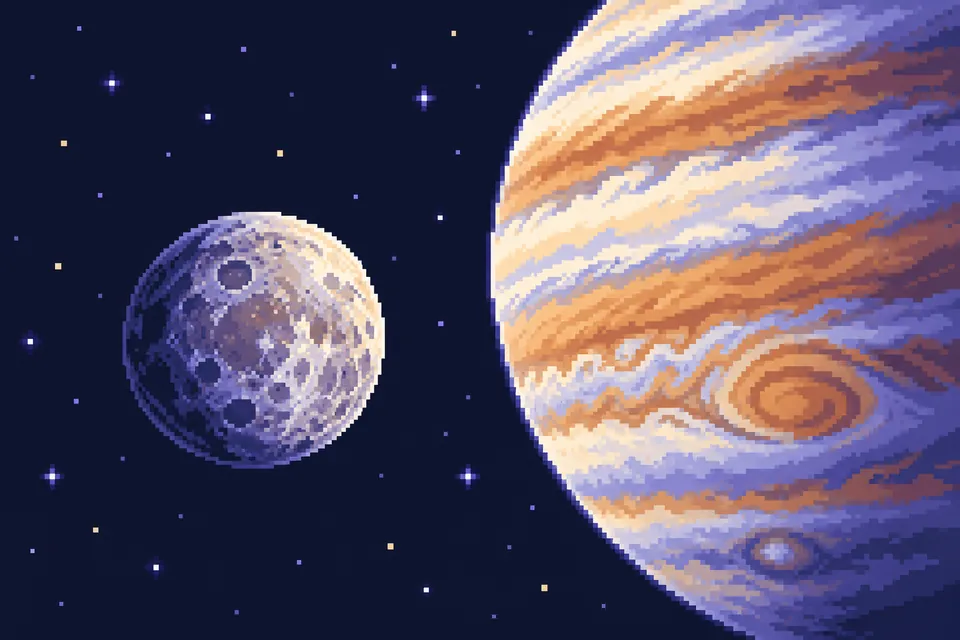
The Galilean set consists of Io, Europa, Ganymede and Callisto. These are a named subset of Jupiter’s moons. The question does not ask for any moon in the solar system or even any moon of Jupiter.
Verify the facts: NASA · Jupiter’s moons ↗
Choose an answer for your goal
Io is only two characters, but earns 46 points. Callisto earns 95 and Ganymede 76. If your practice goal is 65+ points, choosing the shortest name in the whole set will miss that goal. First filter to qualifying scores, then compare the typing effort. This is exactly the distinction between the shortest input and the shortest high-scoring input.
Worked examples — reveals answers
- Io · Accepted
- A Galilean moon; short typing length does not imply a high score.
- Callisto · Accepted
- A member of the named set, worth 95 fixed points.
- Titan · Outside this set
- A moon of Saturn rather than one of Jupiter’s four Galilean moons.
Practice the distinction
Recall one short name and one high-scoring name. Check each without revealing the rest. On a later attempt, identify which of those two goals you want before you type.
Try it in the checker ↑Give me a hint — no answer revealed
Start with the full category, then apply the exact boundary: The four large moons first observed by Galileo in 1610. You only need one qualifying answer. A longer name is not automatically rarer.
Reveal a verified practice pick
This pick belongs to the selected question’s answer set. Points are a fixed knowledge rating.
Reveal a fast high-scoring answer
Shortest accepted input at 65+ points
CallistoCallisto · 95 points · 8 characters
Callisto is one of Jupiter’s four Galilean moons, observed by Galileo in 1610.
Highest fixed score
Callisto95 points · Shortest accepted spelling: Callisto
These are editorial points, separate from real player choice counts.
Reveal all 4 practice answers
Filter by a name or listed alias. Scores are fixed knowledge ratings.
4 accepted answers
No answers match these filters. Try another spelling or a lower minimum score.
What players actually choose
– UTC · 421 recorded daily rounds. Source: Krillionio daily submissions. Skips and timeouts are included in the denominator; practice and Battle are excluded.
122 / 421 rounds ended with an accepted answer (29.0%). Average: 14.0 fixed points.
Compare observed choices — reveals answers
Question quality signals
These measurements cover completed daily rounds recorded with timing and rejection details. Older rounds without those fields are excluded. At least 20 measured rounds are required per question.
This question has fewer than 20 measured rounds.
Review thresholds: below 20% accepted, at least 40% timed out, or at least 30% of rounds with an unlisted input. These flags suggest checking the wording and answer coverage; they do not prove an answer is wrong or change points automatically. Abandoned rounds and practice attempts are not included.
How these statistics work
- What is counted
- Source: Krillionio daily submissions. Skips and timeouts count as rounds; practice and Battle are excluded.
- When comparisons appear
- A question needs at least 20 recorded rounds. An answer also needs at least 5 recorded choices within that question.
- What the data can tell you
- These anonymous browser records are not verified unique people or a representative survey. The player rarity index does not change game points or predict the original Krillion game. Raw submissions stay private.
Rule examples & common mix-ups — may reveal answers
- Match the parent planet and the named subset. Being a real moon is insufficient if it orbits a different planet or falls outside the listed major moons.
These notes explain the question boundary; they are not a ranking of player mistakes.
Why these answers qualify
Each entry belongs to the bounded set defined by the prompt. The named source supports the underlying facts; our editorial scoring is a separate layer.
Source: NASA · Jupiter’s moons ↗
Reference version: 2026-09-13. See our answer policy for how we handle aliases and omissions.